
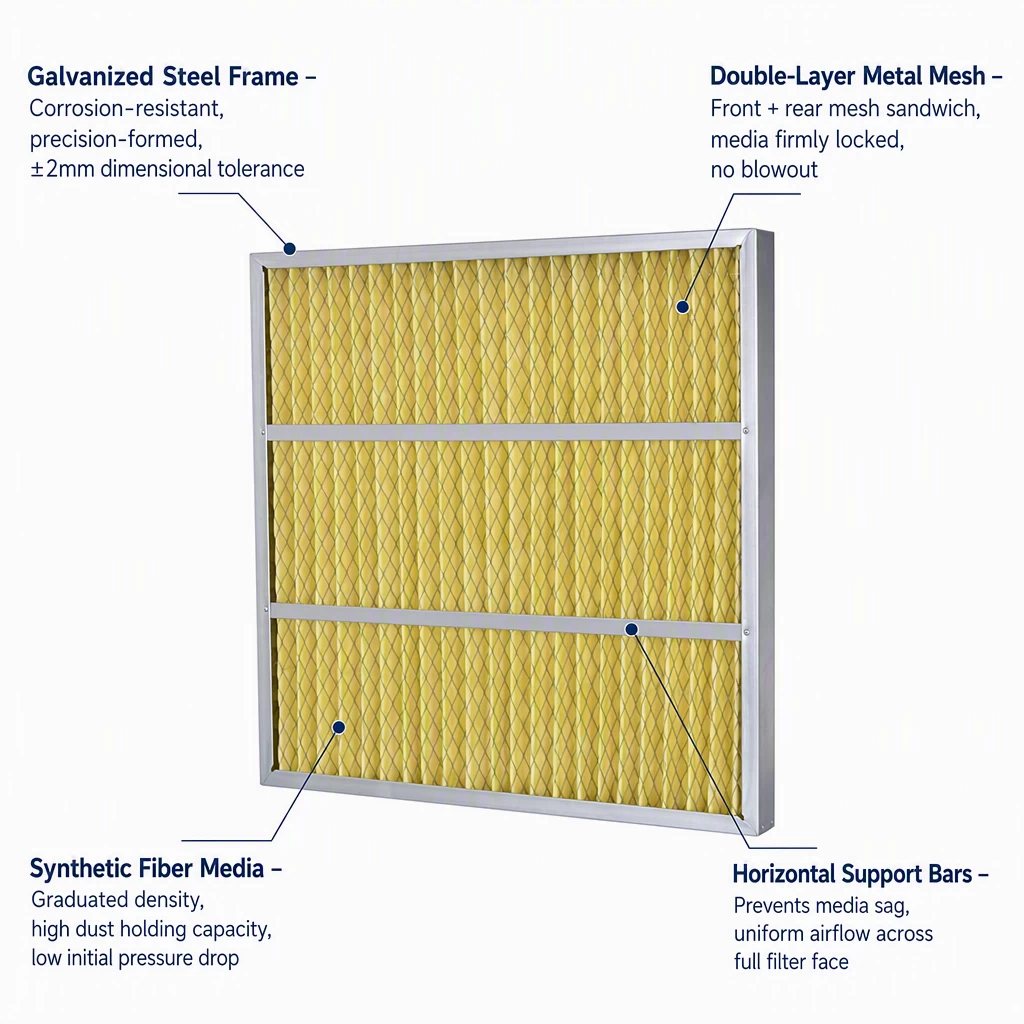
Pleated Dust Filter Cartridge Media Selection: Polyester, PTFE Membrane and Antistatic Options
Two cartridges can look identical from the outside — same diameter, same height, same end caps — and perform completely differently in service. The difference is the media. Choosing the wrong filter material is the most common reason a dust collector underperforms, chokes early or fails an emission test.
The Four Media Families You Will Actually Choose From
Industrial pleated cartridges are built around a small number of base media, each with a distinct operating envelope. Understanding what each one is for removes most of the guesswork from selection.
| Media | Filtration Precision | Max Temperature | Best For | Watch Out For |
|---|---|---|---|---|
| Standard polyester fibre | 0.3 μm | ≤80 °C | General dry dust, powder coating, sandblasting, grinding | Not for humid or chemically aggressive gas |
| High-density polyester with PTFE membrane | 0.3 μm | ≤80 °C | Fine powders, API, catalyst, sticky dust | Higher cost; membrane can be damaged by abrasion |
| Carbon black conductive polyester | 0.3 μm | ≤130 °C | Combustible dust, powder coating, chemical, plastic powder | Requires complete grounding path |
| Glass fibre / high-temperature media | 0.1–0.3 μm | Up to 260 °C depending on grade | Kiln, furnace, welding fume, high-temperature flue gas | More brittle; careful handling during installation |
When Standard Polyester Is the Right Answer
Polyester fibre is the workhorse. It offers excellent dust release, low air resistance and good mechanical strength at a cost that makes it the default choice for the majority of dry dust applications. A high-density polyester cartridge with a deep pleated structure and an integral galvanised steel support frame will handle powder coating overspray, sandblasting dust and general grinding swarf for a long service life.
The limits are equally clear. Standard polyester is not suitable for hygroscopic dust, for condensing gas streams, or for temperatures above 80 °C in continuous operation. Push it beyond those conditions and the media will either blind, hydrolyse or lose dimensional stability.
When You Need a PTFE Membrane
A PTFE membrane is a microporous film laminated to the surface of the base media. It changes the filtration mechanism fundamentally: instead of dust penetrating into the depth of the fibre and gradually blocking it, particles are stopped at the surface and the dust cake becomes the filtration layer.
Three situations justify the added cost:
- Sub-micron powders. API, catalyst, fumed silica and pigment powders below 1 μm penetrate depth media and are difficult to dislodge. Surface filtration keeps pressure drop stable.
- Sticky or agglomerating dust. Where particles bond to fibre, a smooth membrane surface releases the cake far more cleanly during pulse cleaning.
- Tight emission limits. Where the outlet standard requires very low residual concentration, membrane media provides the consistent efficiency needed to stay compliant across a full filter life.
When the Dust Is Combustible: Antistatic Media
If the dust can form an explosive atmosphere, conductive media is not optional. Carbon black conductive polyester fibre creates a continuous grounding path through the full depth of the media, preventing the charge accumulation that leads to brush discharge ignition. Our dedicated article on carbon black antistatic filter cartridges covers the mechanism, the resistivity targets and the installation checks in detail.
Reading a Specification Sheet Correctly
Filter data sheets are written to be compared, but only if you read the right numbers. Four values matter more than the rest:
| Specification | What It Tells You | What to Ignore |
|---|---|---|
| Filtration precision (μm) | The particle size the media reliably intercepts | Marketing claims of "absolute" efficiency without a test standard |
| Filtration efficiency (%) | Capture rate at the stated particle size | Efficiency quoted without the corresponding particle size |
| Air permeability | Pressure drop at a given face velocity | Bare pressure-drop figures with no flow reference |
| Max continuous temperature | Safe long-term operating limit | Short-term peak ratings presented as continuous limits |
Matching Media to Dust Loading
Media selection does not stop at material choice. Pleat density and pleat depth determine how much surface area is packed into a given cartridge volume, and that in turn determines face velocity. Lower face velocity means less particle penetration, slower pressure-drop rise and longer intervals between cleaning cycles.
For heavy dust loading, a lower pleat count with deeper pleats usually outperforms a high pleat count with shallow pleats — the extra depth gives dust somewhere to go during the cleaning cycle instead of packing the pleat valleys solid. For light loading and tight space, higher pleat density delivers more filtration area in the same housing.
Related Reading
Media choice interacts with element construction. For a comparison of locking systems and end-cap design, see CNC oil mist filter cartridges for liquid aerosol handling, or the six-ear quick-release cartridge guide for housing compatibility. Our FAQ collection answers common ordering questions, and the filter cartridge range lists standard media configurations.
Frequently Asked Questions
Can I upgrade a standard polyester cartridge to PTFE membrane without changing anything else?
In most cases yes, provided the housing and pleat geometry are unchanged. The membrane adds a small amount of pressure drop at the same face velocity, so confirm that the fan has sufficient margin.
Is a higher filtration efficiency always better?
Not automatically. Higher efficiency usually means tighter media and higher pressure drop, which costs fan energy. The correct target is the efficiency needed to meet the emission standard, not the highest figure available.
How do I know when the media has reached end of life?
Track differential pressure. A cartridge that no longer returns to its baseline pressure drop after a cleaning cycle, or that shows visible pleat deformation or media damage, should be replaced regardless of elapsed time.
Conclusion
Media selection is the single highest-leverage decision in specifying a pleated dust filter cartridge. Match the base material to the dust chemistry, the temperature and the moisture; add a PTFE membrane where sub-micron or sticky dust demands surface filtration; and use conductive media wherever combustible powder is present. FENGCHENG supplies all four media families with custom pleat density, diameter and height to match your collector.
Send us your dust analysis, gas temperature and required emission limit, and our engineers will recommend the correct media specification within 24 hours.