
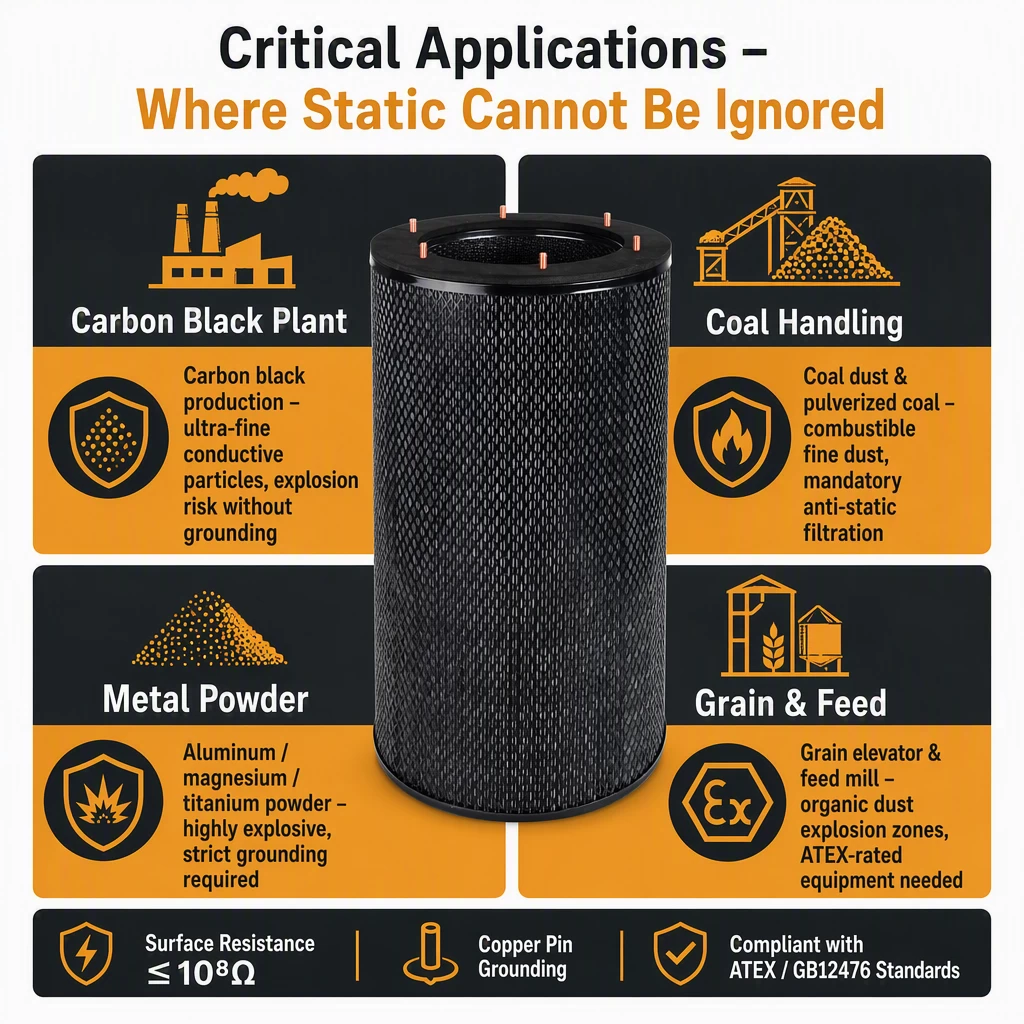
Carbon Black Antistatic Filter Cartridges: How Conductive Media Prevents Dust Explosions
Combustible dust is one of the most underrated hazards in industrial production. A polypropylene powder, an aluminium pigment or a fine sugar dust cloud can ignite from a single electrostatic discharge that a worker never feels. Carbon black antistatic filter cartridges exist for exactly this reason: they turn the filter element itself into a grounding path, so static charge never accumulates in the first place.
Why Static Charge Builds Up Inside a Dust Collector
Every time dust particles collide with the filter media, with each other and with the ductwork, electrons transfer between surfaces. In a non-conductive filter — standard polyester, for example — that charge has nowhere to go. Surface resistivity of ordinary synthetic media sits in the 1014–1016 Ω range, which means the cartridge behaves like an insulator.
The consequences build in three stages. First, charge accumulates on the pleat surface and on the dust cake. Second, the voltage gradient reaches the breakdown threshold of the surrounding air. Third, a brush discharge or a propagating brush discharge releases the stored energy — in a confined, dust-laden enclosure, that is enough to initiate an explosion.
Pulse-jet cleaning makes this worse, not better. Every cleaning cycle violently separates the dust cake from the media, generating a fresh burst of triboelectric charge. A collector running 100,000 pulse cycles per year is generating static thousands of times per shift.
How Carbon Black Conductive Media Works
A carbon black antistatic filter cartridge uses conductive polyester fibre needle felt as the filtration layer. Carbon black particles are integrated into the fibre structure itself rather than applied as a surface coating, so the entire depth of the media forms a continuous, three-dimensional conductive network.
That network is bonded to the outer and inner support mesh, which is galvanised steel or stainless steel depending on the application. The mesh is mechanically connected to the end caps and, through the cartridge housing, to the earthed collector body. The result is a complete grounding chain: dust cake → conductive fibre → support mesh → end cap → earthed housing.
Because conduction happens through the full fibre matrix, there are no insulated islands where charge can pool. Surface resistivity of a properly manufactured conductive medium typically falls to the 104–106 Ω range — low enough to bleed off charge as fast as it is generated, while remaining far above the short-circuit condition that would create a spark of its own.
Specifications of FENGCHENG Carbon Black Antistatic Filter Cartridges
| Parameter | Technical Specification |
|---|---|
| Filter material | Carbon black conductive polyester fibre needle felt |
| Inner / outer mesh | Galvanised steel or stainless steel protective mesh |
| Filtration precision | 0.3 μm ultra-fine powder particles |
| Filtration efficiency | ≥99.5% dust interception rate |
| Antistatic principle | Carbon black fibre overall conduction; eliminates static accumulation |
| Working temperature | ≤130 °C continuous operating temperature |
| Cleaning method | Pulse-jet air cleaning, reusable |
| Core performance | Full anti-static, high dust holding, low resistance, wear resistant, no fibre shedding |
| Structure | Pleated deep filtration, large filter area, stable pressure drop |
| Customisation | Custom diameter, height, end cap structure, mesh material and pleat density |
Where Antistatic Cartridges Are Mandatory
Any process that generates combustible dust below the minimum ignition energy threshold of the material needs conductive filtration. In practice, four categories dominate:
- Powder coating and paint manufacturing — epoxy, polyester and hybrid powders are organic, finely divided and frequently handled in high concentrations.
- Chemical and pharmaceutical powder handling — API milling, catalyst production and fine chemical drying all generate dust clouds with low ignition energy.
- Plastic and rubber processing — plastic powder, PVC compounding and rubber crumb grinding.
- Food and agricultural powders — sugar, starch, flour, cocoa and grain dust are all combustible at the right concentration and particle size.
If your process falls into one of these categories and the collector sits inside a building, an antistatic element is not an upgrade option — it is a safety requirement under most national dust hazard regulations, and it is normally a precondition for ATEX or equivalent hazardous-area classification.
Antistatic vs Standard Cartridge: What Actually Differs
| Aspect | Standard Polyester Cartridge | Carbon Black Antistatic Cartridge |
|---|---|---|
| Media | Standard polyester fibre | Carbon black conductive polyester fibre |
| Surface resistivity | 1014–1016 Ω (insulating) | Approx. 104–106 Ω (conductive) |
| Grounding path | None | Fibre → mesh → end cap → earthed housing |
| Discharge risk | High in combustible dust | Bleeds charge continuously |
| Dust holding | Standard | High, with stable pressure drop |
| Typical use | Inert dust, non-hazardous zones | Powder coating, chemical, plastic, food powder |
| Cost | Lower | Modest premium, offset by safety compliance |
Installation Rules That Determine Whether It Actually Works
A conductive cartridge only performs if the grounding path is complete. Three installation details are routinely overlooked:
- The tube sheet must be earthed. A conductive cartridge in an unearthed housing is an isolated conductor and offers no protection at all.
- Continuity must be measured after installation. A resistance check between the cartridge mesh and the collector earth point should read within the manufacturer’s specified limit — not open circuit.
- Replacements must stay conductive. Fitting a standard polyester element into a collector that was designed with antistatic media silently removes the explosion protection the system was engineered around.
Choosing the Right Antistatic Cartridge
Selection follows the same four parameters as any pleated dust cartridge — dust type, gas temperature, housing compatibility and emission target — with conductive media as a fixed constraint. Beyond that, confirm that the mesh material matches the corrosion environment (stainless steel for humid or chemically aggressive gas), and that the pleat density is matched to the dust loading.
For a broader look at how cartridge construction affects performance, see our guide to six-ear quick-release dust filter cartridges. If you are sourcing across a full plant, the Buying Guide collection covers supplier verification and specification comparison, while our filter cartridge range lists the standard antistatic configurations available.
Frequently Asked Questions
Can I use an antistatic cartridge in a collector that was not originally ATEX rated?
The cartridge improves the electrostatic situation but does not by itself make a collector ATEX compliant. Explosion venting, grounding of the housing, and the classification of the surrounding zone also have to be addressed. FENGCHENG can supply material traceability documentation to support your ATEX dossier.
Does conductive media reduce filtration efficiency?
No. The carbon black is integrated into the fibre structure, so the pore size distribution and the 0.3 μm filtration precision are unchanged. Independent testing on FENGCHENG antistatic cartridges shows a dust interception rate of ≥99.5%.
How do I verify the grounding is intact?
Measure resistance between the inner support mesh and the earthed collector body with a calibrated low-resistance meter. Record the reading at commissioning, then re-check it whenever cartridges are replaced.
Conclusion
Carbon black antistatic filter cartridges solve a problem that standard filtration media cannot: they remove the insulating barrier between dust and earth. For any process handling combustible powder, that is the difference between a compliant installation and an unmanaged ignition source. FENGCHENG manufactures conductive cartridges with a continuous fibre-level grounding network, verified 0.3 μm precision and full customisation on diameter, height and end-cap geometry.
Send us your dust type, collector model and target emission level, and our engineering team will confirm the correct antistatic specification — usually within 24 hours.