
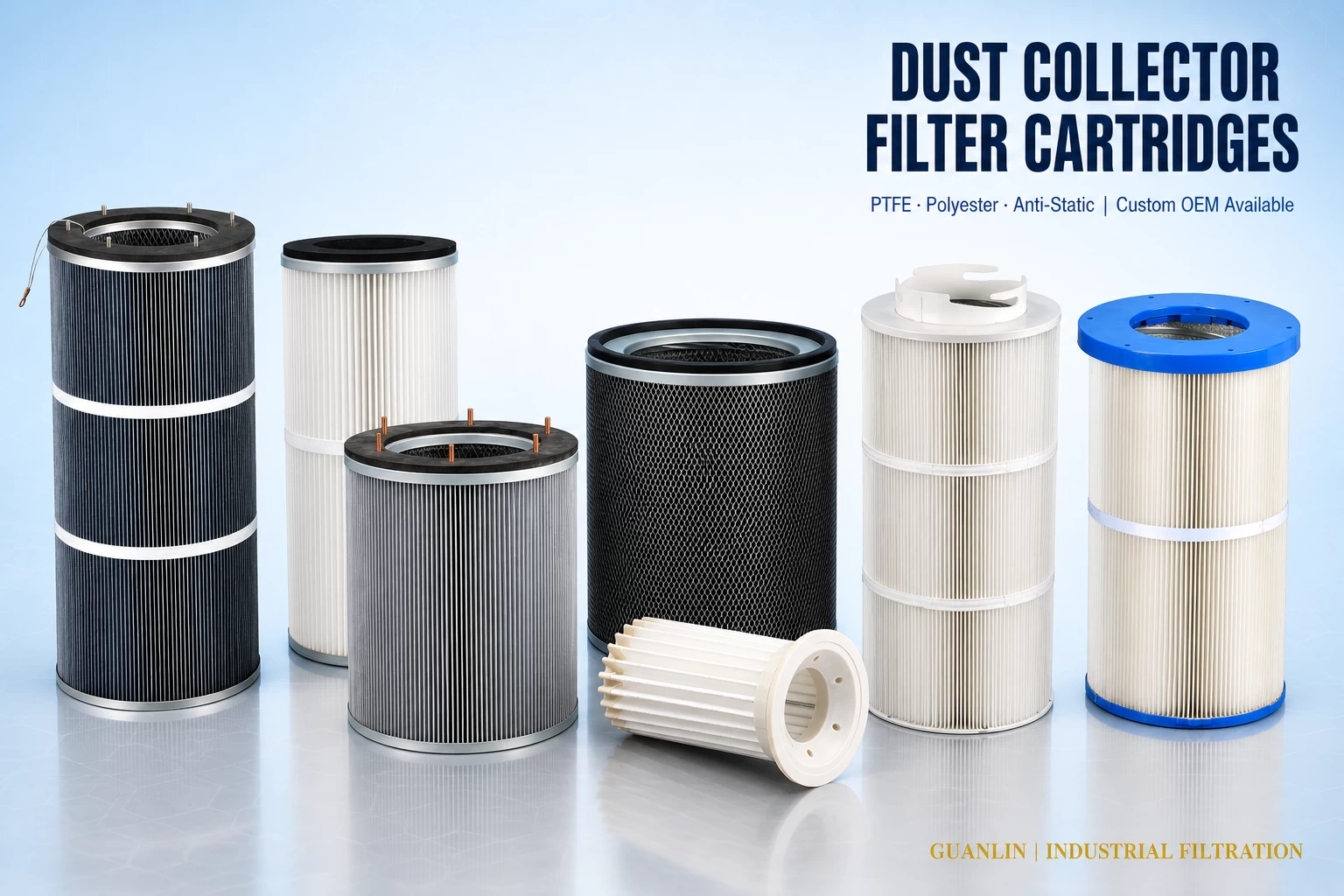
CNC Oil Mist Filter Cartridges: 0.1 μm Gradient Media and Closed-Loop Oil Recovery
Oil mist is the hidden cost centre of every machining shop. It fogs the workshop, coats every surface, enters the lungs of operators and gradually degrades the electrical cabinets that control the machines. A properly specified oil mist filter cartridge does two jobs at once: it captures sub-micron aerosol, and it returns the captured cutting fluid to the machine.
What Oil Mist Actually Is
Coolant applied at the cutting edge does not simply evaporate. High-pressure delivery, rapid tool rotation and the heat of the cut atomise the fluid into an aerosol with a bimodal particle size distribution. The coarse fraction — droplets above roughly 2 μm — settles out quickly and is visible as the wet film on machine surfaces. The fine fraction, typically 0.1 μm to 1 μm, stays airborne almost indefinitely and is the fraction that reaches the deep lung.
This is why a coarse mesh demister is not sufficient. A filter element rated at 2 μm or 5 μm will catch the visible mist while the respirable fraction passes straight through. Effective oil mist control requires capture at 0.1 μm.
Gradient Media: Coarse Outside, Fine Inside
A CNC oil mist filter cartridge uses gradient glass fibre composite media with an outer-coarse, inner-fine structure. The design is deliberate. If the finest layer were on the outside, it would blind almost immediately under heavy oil loading and pressure drop would climb steeply. By staging the structure, the outer layer removes the bulk of the oil as a coalescing stage, the middle layer drains that liquid downward, and the inner fine layer performs final capture at 0.1 μm.
Each stage holds what it captures without passing the load to the next. The result is a cartridge that maintains low air resistance across its full service life rather than choking in the first few weeks.
Specifications of FENGCHENG CNC Oil Mist Filter Cartridges
| Parameter | Technical Specification |
|---|---|
| Filter material | High-density glass fibre / composite polyester gradient media |
| Outer / inner frame | Galvanised steel or stainless steel protective mesh |
| Filtration precision | 0.1 μm ultra-fine oil mist particle |
| Filtration efficiency | 99.8% – 99.9% oil mist removal rate |
| Working temperature | ≤80 °C long-term continuous operation |
| Core performance | Gradient adsorption, high oil holding capacity, low air resistance, oil return recyclable, anti-corrosion, no fibre shedding |
| Structure | Outer coarse / inner fine gradient with self-drainage oil return design |
| Process | Integrated folding and bonding, double-layer protective mesh, end cap reinforcement, leak-proof sealing |
| Applications | CNC lathe, milling machine, machining centre, industrial oil mist collector, workshop oil smoke purification |
| Customisation | Custom diameter, height, mesh material and filtration grade |
Closed-Loop Oil Recovery: Turning Waste Back Into Coolant
The self-drainage design is what separates a functional oil mist cartridge from an expensive consumable. Captured oil coalesces on the fibre surfaces, migrates downward under gravity along the pleat channels, and drains from the bottom of the element back into a collection point — typically routed to the machine’s coolant sump.
The economics are straightforward. A machining centre running three shifts can lose a meaningful fraction of its coolant charge to mist carry-over every month. Recovering that fluid reduces both the coolant purchase cost and the hazardous-waste disposal cost, and it does so without any additional equipment. For shops running multiple machines, the payback period on a gradient media cartridge is usually measured in months.
Oil Mist Cartridge vs Standard Dust Cartridge
| Aspect | Standard Dust Cartridge | CNC Oil Mist Cartridge |
|---|---|---|
| Target contaminant | Dry particulate dust | Liquid aerosol / oil mist |
| Media structure | Uniform pleated fibre | Gradient: coarse outside, fine inside |
| Filtration precision | 0.3 μm typical | 0.1 μm |
| Liquid handling | Not designed for liquid loading | Coalescing and self-drainage |
| Pressure drop behaviour | Rises with dust cake | Stays low; liquid drains continuously |
| Recovery | Dust discharged as waste | Oil returned to coolant circuit |
| Typical application | Baghouse, powder coating | CNC workshop, machining centre |
Correct Sizing for a Machine Shop
Undersizing is the single most common installation error. An oil mist collector needs to move enough air to capture mist at the source, which means the cartridge must be rated for the actual volumetric flow of the extraction system — not the nominal rating of the housing. Three practical checks:
- Match cartridge flow rating to fan curve. A cartridge operating above its rated face velocity will carry oil through the media and re-entrain it downstream.
- Confirm the housing seal. Oil mist finds leaks. End-cap sealing and housing gaskets must be rated for continuous liquid exposure.
- Plan the drain path. The self-return feature only works if the collected oil has a clear, gravity-fed route back to the sump without pooling.
Related Reading
Oil mist and dry dust are often handled in the same facility, and the media choices differ sharply. Our guide to carbon black antistatic filter cartridges covers the conductive media required wherever combustible powder is present, and pleated dust filter cartridge media selection compares polyester, PTFE membrane and antistatic options for dry applications. For the full element range, see our filter cartridge collection, and for custom dimensions see the Customization & OEM/ODM collection.
Frequently Asked Questions
How often should a CNC oil mist cartridge be replaced?
Replacement is driven by pressure drop, not by a calendar. Monitor the differential pressure across the element and replace when it reaches the fan manufacturer’s limit — typically after 6 to 12 months on a three-shift machining centre, depending on coolant type and mist loading.
Can the cartridge be cleaned and reused?
Gradient oil mist cartridges are not washable in the way dry dust cartridges are. Cleaning risks collapsing the gradient structure and destroying the coalescing performance. Replace rather than clean.
Does the cartridge work with water-miscible coolant as well as neat oil?
Yes, but specify the media accordingly. Water-miscible coolants produce a mixed aerosol, and the support mesh should be stainless steel to resist the moisture. Confirm your coolant type when ordering.
Conclusion
A CNC oil mist filter cartridge earns its place through two mechanisms that must both work: gradient media that captures 0.1 μm aerosol at 99.8–99.9% efficiency, and a drainage structure that returns the captured fluid to the machine. FENGCHENG manufactures both into a single element, with custom diameters, heights and filtration grades available for any collector footprint.
Tell us your machine type, coolant and extraction flow rate, and we will specify the correct gradient cartridge for your workshop.